

Epicurus on AI: Philosophical Implications | Generative ai Google | Microsoft Generative ai Tools Download | Generative ai Financial Services Mckinsey | Turtles AI
Epicurus on AI: Philosophical Implications
DukeRem30 April 2023
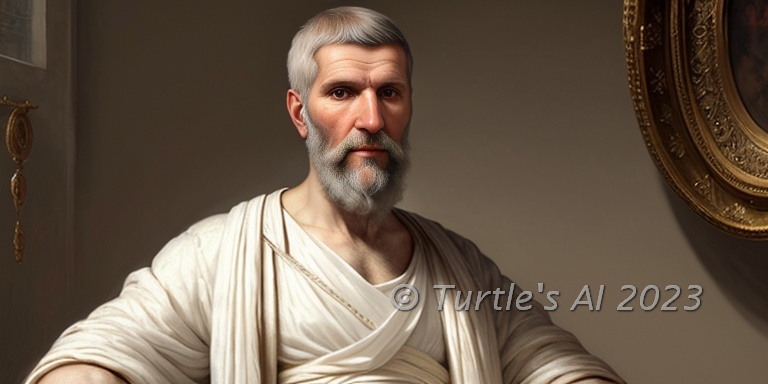
#Epicurus, the #ancient #Greek #philosopher who founded the #Epicurean #school of #thought, centred his #philosophy around the pursuit of #happiness, which he believed could be achieved by attaining a life of #pleasure, #tranquillity, and #freedom from #fear.
In this post, we will explore how Epicurus might have reacted to the concept of #AI, considering its recent advancements and the potential implications for his philosophical constructs. First, we will provide a brief overview of Epicureanism, followed by a description of artificial intelligence from an Epicurean perspective. Finally, we will discuss Epicurus's potential judgment on AI and its implications for human well-being.
Epicureanism: A Brief Overview
Epicurus's philosophy is built on the foundation of atomism, the belief that the universe is composed of indivisible and eternal atoms that interact with one another in a void. According to Epicurus, the soul is also made of atoms, and it ceases to exist when the body dies, leading to a state of non-existence. Consequently, Epicurus argues that the fear of death is irrational, as death represents the absence of sensation and consciousness. The ultimate goal of an Epicurean is to achieve ataraxia, a state of tranquillity and freedom from fear and mental disturbance. This can be attained through the pursuit of pleasure, which Epicurus defines as the absence of pain (aponia) and the satisfaction of one's desires. However, he distinguishes between natural and necessary desires, which are essential for happiness, and unnatural and unnecessary desires, which may lead to suffering when pursued.Artificial Intelligence Through an Epicurean Lens
In order to understand how Epicurus might have perceived artificial intelligence, it is essential to consider how AI could be interpreted within the framework of atomism. AI can be viewed as a complex arrangement of atoms, organized in such a way as to create computational systems capable of learning, reasoning, and problem-solving. These systems, like all other physical entities, are subject to the laws of nature and the interactions of atoms in the void. From an Epicurean standpoint, AI systems can be considered advanced tools humans developed to achieve specific goals, such as improving efficiency, optimizing decision-making, and solving complex problems. As such, AI can be seen as a means to an end, rather than an end in itself. This perspective aligns with the Epicurean view of other technological advancements, which are valued for their ability to contribute to human well-being and the pursuit of ataraxia.Epicurus's Judgment on Artificial Intelligence
Epicurus's judgment on artificial intelligence would likely depend on its ability to contribute to the attainment of pleasure and the avoidance of pain. He would likely emphasize the importance of using AI responsibly and ethically, considering the potential consequences of its application on human well-being.- Positive implications: Epicurus might have appreciated the numerous ways in which AI can enhance human lives, such as by improving medical diagnoses, reducing the need for manual labour, and providing personalized educational experiences. These advancements could contribute to a reduced experience of physical and mental pain, aligning with the Epicurean pursuit of aponia.
- Negative implications: On the other hand, Epicurus might have expressed concerns about the potential negative consequences of AI, such as job displacement, privacy violations, and the exacerbation of social inequalities. These issues could lead to increased suffering and a reduced sense of tranquillity, countering the desired state of ataraxia.
- AI and mortality: Considering Epicurus's perspective on death and the soul, he would likely not view AI as a means to achieve immortality or the continuation of consciousness after death. Since the soul is composed of atoms and ceases to exist upon the dissolution of the body, AI could not provide a means for preserving the soul or transferring it to a computational system.