

Social Model based on LLM | Hands - on Large Language Models pdf Github | Is Chatgpt Generative ai | Llm Training Dataset Free | Turtles AI
Social Model based on LLM
DukeRem19 April 2023
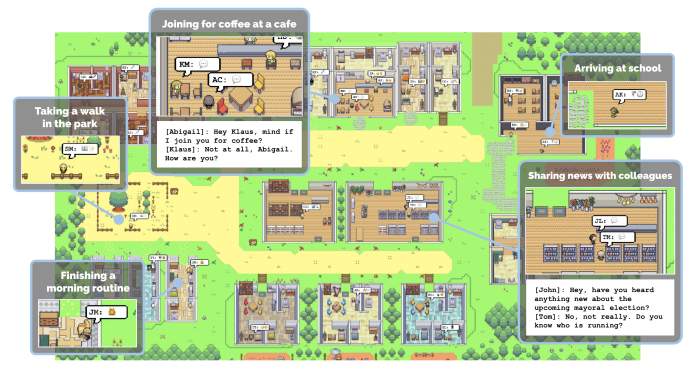
In a recent paper published by #Google and #Stanford #University, researchers have introduced the concept of #generative #agents - computational software agents that simulate believable human behaviour. These agents can perform a range of tasks, from cooking breakfast and going to work, to painting and writing. They form opinions, notice each other, initiate conversations and remember and reflect on past experiences and, most notably, interact among them.
The researchers describe an architecture that extends a large language model ( LLM ) to store a complete record of the agent's experiences in natural language, synthesize those memories over time into higher-level reflections, and retrieve them dynamically to plan behaviour. To demonstrate the capabilities of generative agents, the researchers instantiated them to populate an interactive sandbox environment inspired by The Sims.
In an evaluation, these generative agents produced believable individual and emergent social behaviours. Starting with only a single user-specified notion that one agent wants to throw a Valentine's Day party, the agents autonomously spread invitations to the party over the next two days, made new acquaintances, asked each other out on dates to the party, and coordinated to show up for the party together at the right time.
The evaluation also revealed that the components of the agent architecture - observation, planning, and reflection - each contribute critically to the believability of agent behaviour. The full architecture of generative agents generates the most believable behaviour among all study conditions. However, the researchers also reported that the full architecture was not without flaws and illustrated its modes of failure.
While offering new possibilities for human-computer interaction, generative agents also raise important ethical concerns that must be addressed. One risk is people forming parasocial relationships with generative agents even when such relationships may not be appropriate. Users may anthropomorphize generative agents or attach human emotions to them. To mitigate this risk, the researchers propose that generative agents should explicitly disclose their nature as computational entities, and developers must ensure that the agents, or the underlying language models, be value-aligned so that they do not engage in behaviours that would be inappropriate given the context, such as reciprocating confessions of love.
Generative agents may also exacerbate existing risks associated with generative AI, such as deep fakes, misinformation generation, and tailored persuasion. To mitigate this risk, the researchers suggest that platforms hosting generative agents maintain an audit log of the inputs and generated outputs, so that it is possible to detect, verify, and intervene against malicious use.
Despite these concerns, generative agents offer a promising new direction for interactive computing. The researchers suggest that generative agents can play roles in many interactive applications ranging from design tools to social computing systems to immersive environments. With further research and development, generative agents could revolutionize the way we interact with computers and with each other.