

Carcass of a Very Rare Cetacean Found on a Beach in New Zealand. | Festina Lente - Your leading source of AI news | Turtles AI
Carcass of a Very Rare Cetacean Found on a Beach in New Zealand.
Editorial Team22 July 2024
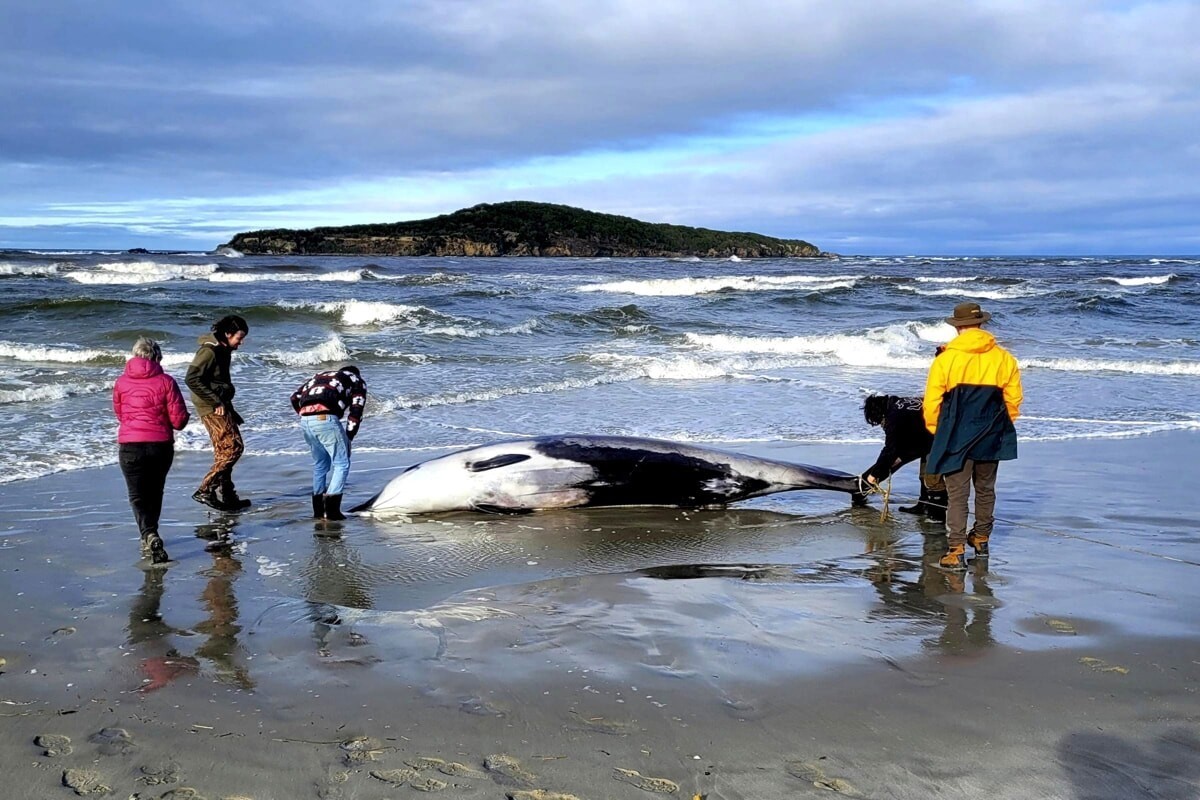
Virtually unknown Spatulate-Toothed Whale Discovered in New Zealand
A sensational event recently caught the attention of marine scientists: the discovery of the carcass of an extremely rare spatulate-toothed whale, also known as Mesoplodon traversii, on the coast of New Zealand. This specimen, about five meters long, was found near the mouth of the Taieri River in the Otago region of the South Island.
The discovery, made on July 4, represents a unique opportunity to learn more about this mysterious cetacean species, about which very little is still known. Since the 1800s, only six specimens have been documented worldwide, with only one found outside New Zealand.
The Identification and Importance of the Discovery.
Currently, the whale’s remains are in cold storage, while samples of its DNA have been sent to the University of Auckland to confirm the specimen’s identity. Final confirmation could take several weeks or months, according to experts.
Gabe Davies, operations manager for the Department of Conservation on the Otago coast, told local media that the whale has been identified as a male. "These whales are one of the most misunderstood large mammal species of modern times," Davies pointed out.
A Journey Through Time: The First Findings.
Mesoplodon traversii was first described in 1874 by John Edward Gray, based on a lower jaw and two teeth found in the Chatham Islands off the east coast of New Zealand. This early specimen, along with the remains of other specimens found in New Zealand and Chile, helped confirm the existence of the species, but many questions remain unanswered.
Research Challenges
The extreme rarity of this species makes scientific investigations particularly complex. Scientists do not know exactly where it lives, what it eats or what its habits are. The scarcity of sightings of living specimens and the lack of behavioral data add further difficulties to the study of this species.
Future Perspectives
The discovery of this stranded specimen offers a great opportunity for in-depth studies that could unveil new details about the biology and ecology of Mesoplodon traversii. Experts from the Department of Conservation and Te Papa National Museum are already at work analyzing the collected specimens and planning the next steps of research.
A Discovery of International Significance.
The discovery of this rare whale has attracted the interest of the international scientific community. "The rarity of this whale means that conversations about what to do next will take longer," the experts explained, stressing the importance of a coordinated, interdisciplinary approach to tackling future research.
In conclusion, the discovery of Mesoplodon traversii on New Zealand’s coast represents an important milestone in the understanding of one of our planet’s most elusive and fascinating marine species. It is hoped that this event will help fill the many knowledge gaps and promote further studies and discoveries in the field of marine biology.