

The transparent sentinels of the deep sea | Festina Lente - Your leading source of AI news | Turtles AI
The transparent sentinels of the deep sea
Microchip-guided jellyfish swim like living drones, drawing vortices with starch powders and taking science to the depths where robots struggle to reach
Editorial Team25 August 2025
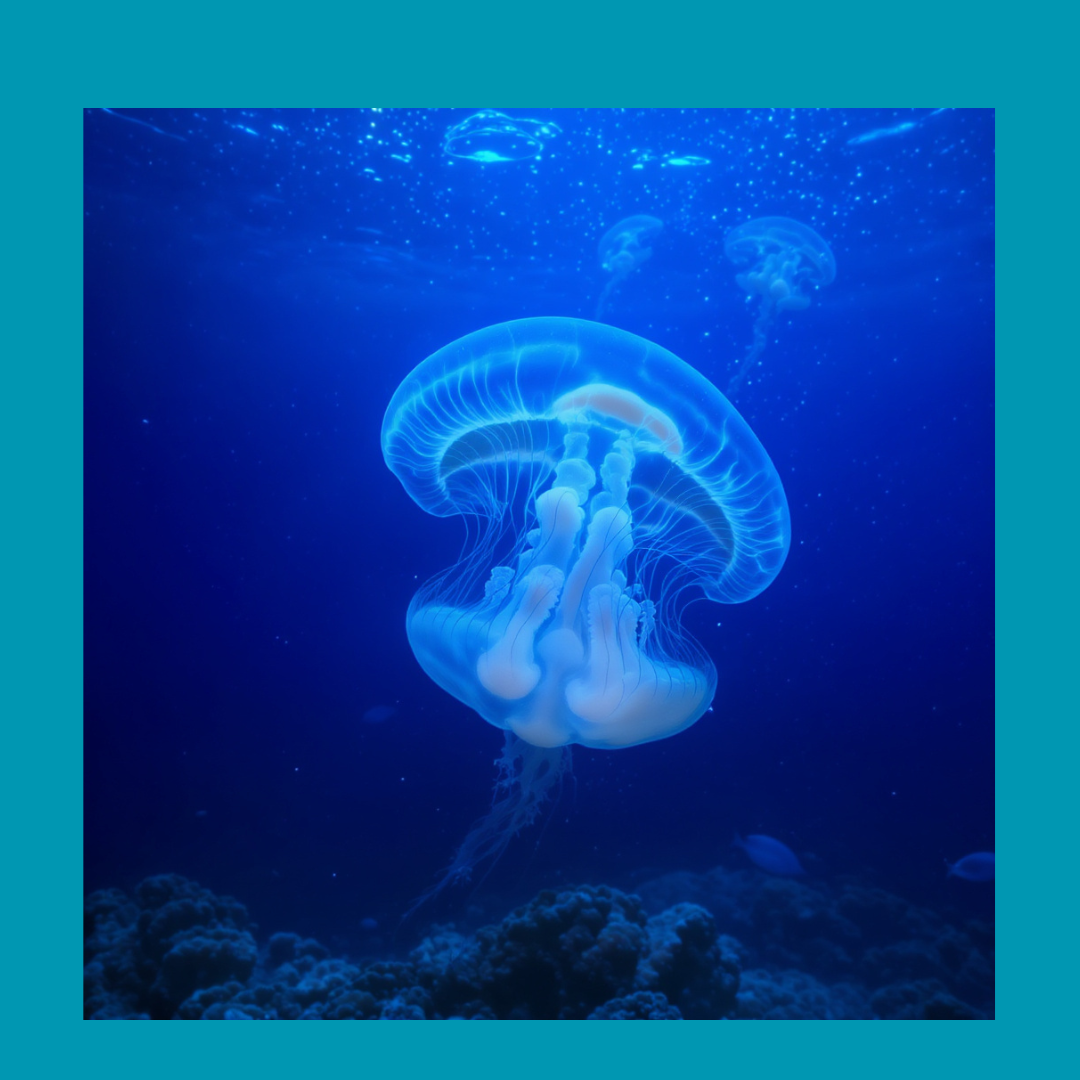
"Cyborg" moon jellyfish, equipped with pacemaker-like microelectronics, are being guided by CU Boulder researchers into deep-ocean environments, while the use of biodegradable particles like starch revolutionizes flow visualization: a marriage of nature and underwater exploration.
Key Points:
- Pacemaker devices stimulate the jellyfish’s muscles to guide them through the deep ocean.
- Biodegradable particles, like cornstarch, are used instead of toxic synthetic traces.
- Moon jellyfish are among the most efficient swimmers: an ideal model for eco-friendly instruments.
- Researchers monitor animal welfare, observing normal behavior and reproduction
In a neon-lit laboratory, where moon jellyfish, Aurelia aurita, seem to float like spaceships suspended in space, engineer Nicole Xu monitors their movements with the gaze of someone who knows she has a fascinating yet delicate opportunity at her fingertips. For over a decade, Xu has studied their fluid and incredibly energy-efficient swimming dance; prehistoric animals lacking a brain or spinal cord, but equipped with essential nerve networks, they have survived the ages without altering a structure as simple as it is effective.
Now, from Boulder, Xu has transformed that natural potential into a scientific ally: small microelectronics mounted like pacemakers on the jellyfish’s body stimulate their swimming muscles and propel them in the desired direction, allowing them to explore ocean depths where expensive robots would struggle. In the past, the jellyfish came from Mount Science: tests were conducted in the coastal waters of Woods Hole, Massachusetts, as early as 2020.
The challenge is twofold: on the one hand, exploiting their elegance and safety (their stinging cells do not penetrate human skin) as a means of detection; on the other, doing so sustainably. Conventional solutions such as glass microspheres or polystyrene beads for analyzing water flow are expensive (up to $200 per kilogram) and potentially harmful to the environment and organisms. The breakthrough? The use of biodegradable particles such as cornstarch or arrowroot, suspended in water and illuminated by lasers: these are economical alternatives (about $2 per kilogram) and equally effective for visualizing the vortices and trails produced by moving jellyfish.
In particular, arrowroot starch stands out for its uniform particle size and laser brilliance, while cornstarch is more suitable for larger tracks. Meanwhile, Xu and his team, including Yunxing Su, Mija Jovchevska, and Charlie Fraga, are working to make the jellyfish even more maneuverable and studying ethical issues often overlooked in invertebrate research: they monitor mucus production, polyp reproduction, and other signals, thus far confirming the animals’ well-being.
Beyond simply collecting environmental data—temperature, acidity, salinity—Xu aims to inspire a new generation of marine vehicles: silent, efficient, perfectly attuned to currents, shaped by the primordial rhythm of the jellyfish. Other teams, such as the one at Caltech, are also exploring similar solutions; for example, microcontrollers equipped with sensors in a waterproof casing and a ballast system to maintain vertical orientation, but without yet offering full horizontal maneuverability.
This fusion of nature and microtechnology redefines the concept of ocean exploration, opening up new avenues that are more accessible, widespread, and less invasive than traditional submarines: a mosaic of cyborg jellyfish ready to act as silent messengers of the sea depths.