

When robots learn to dance with their bodies | Best microsoft generative ai tools | Generative ai google course | Generative ai mckinsey | Turtles AI
When robots learn to dance with their bodies
From Shannon’s theorem to non-verbal gestures: the new frontier of human-machine communication passes through limbs, glances and postures, because without incarnation even the algorithm remains silent
Editorial Team24 August 2025
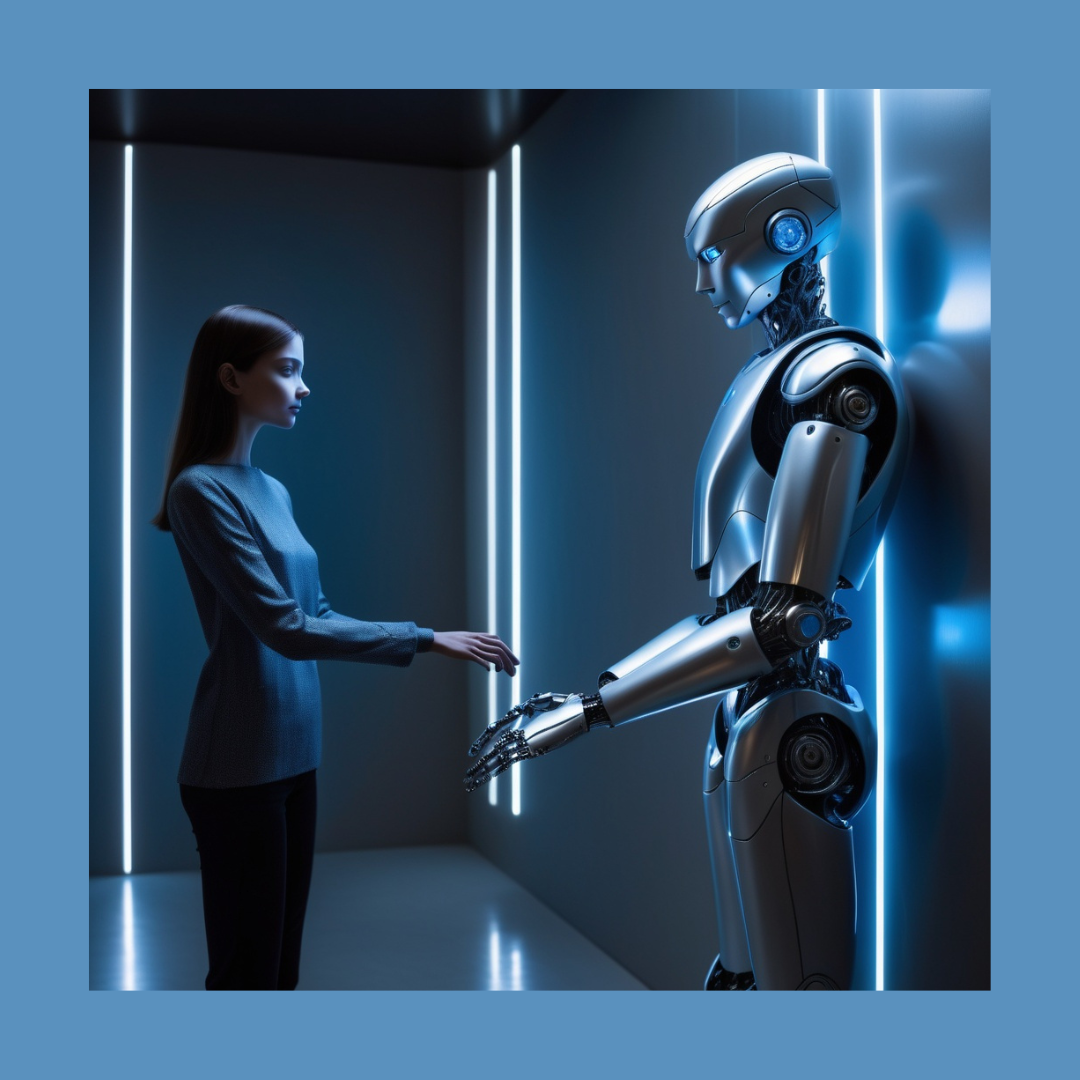
A fresh approach that rethinks human-robot communication: a brain in a box isn’t enough; we need a smart body that communicates with the environment. Using Shannon as a guiding light, we build a clear model of embodied intelligence and meaningful communication.
Key points:
- Robot-human communication changes when the body becomes an active channel.
- Shannon helps measure capacity and noise, from a robotic perspective.
- Physical intelligence (PI) is as important as cognitive intelligence (CI), especially in today’s volatile environment.
- Nonverbal signals—gesture, posture, rhythm—transform a robot from a cold device to an empathetic partner.
Immersing yourself in human-robot communication means expecting that touch of poetry that comes from the speaking body: as in animals, every muscle, gaze, and micromovement is a message, redundant and subtle. To maintain a dialogue, robots can’t settle for digital brains that transform data into actions: they must learn to use their bodies as a vital medium, as living beings do. And here’s the twist: for everything to work, a rigorous mapping is needed, a mathematical lens like Shannon’s with its channels, noise, and redundancies. In classical communication, according to Shannon and Weaver, there is a sender, transmitter, channel, receiver, and destination: a linear flow in which noise can intrude, but hey, a little redundancy helps restore the lost meaning. Well: let’s put the robot’s body in place of the mere digital channel. Sensors, actuators, conformation, position—what scholars call informational embodiment—become parts of a physical channel in which entropy, noise, and capacity are truly measured. In a brilliant article from 2025, a human-robot communication framework is proposed that is based precisely on this: intelligent embodiment + information theory = solid tools and benchmarks for designing more human and less rigid communication systems. Meanwhile, on the physical side, recent literature emphasizes that robot intelligence must be accompanied by physical intelligence, the so-called PI, which must work in tandem with cognitive intelligence (CI): these include materials, mechanics, bio-inspired design, self-assembly, robots that "think" with their bodies, not just their chips. In short, that body that is not just a shell, but an active participant in communication: there is study and design, for example in soft robotics, where the artificial hand learns to pick up objects with simplicity and economy of control, almost becoming an intuitive extension of the person using it. And that’s not all: nonverbal signals also matter: our gestures, our gaze, even smell, and why not, temperature activate rich channels that keep the dialogue alive, making it credible, "alive," even pleasant. Communication thus becomes polyphonic, not a mere exchange of bits. Rather, it is a symphony of physical and symbolic impulses that intermingle and support each other. The model is thus enriched: not only Shannon, but also asymmetric approaches highlight the differences between humans and robots, and suggest how to design more effective interfaces, because we are not the same but we can understand each other.
Here is a robot that doesn’t simply execute commands, but responds and perhaps anticipates you with a gesture, a sway, an expression that isn’t there but you can feel.