

A New Map for AI: The Periodic Table of Machine Learning is Born | Large language models tutorial pdf free | Most popular large language models in the world | Large language models coursera | Turtles AI
A New Map for AI: The Periodic Table of Machine Learning is Born
MIT team develops framework that connects more than 20 machine learning algorithms through a single equation, paving the way for designing new models and improving existing ones
Editorial Team25 April 2025
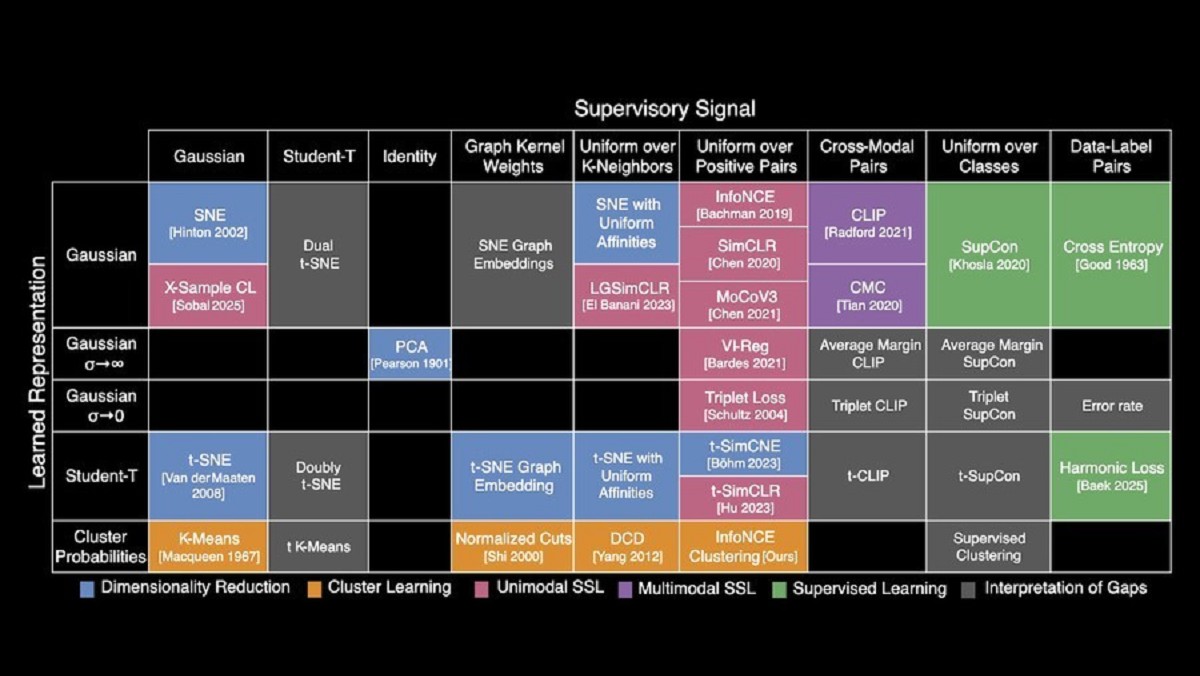
An MIT team has developed I-Con, a framework that organizes over 20 machine learning algorithms into a “periodic table,” revealing common mathematical connections and predicting new algorithms, improving efficiency and innovation in AI.
Key Points:
- I-Con unifies over 20 machine learning algorithms through a single mathematical equation.
- The framework led to the creation of a new image classification algorithm with an 8% improvement over existing approaches.
- I-Con’s “periodic table” highlights gaps that suggest undiscovered algorithms.
- I-Con provides a toolkit for designing new algorithms by combining existing strategies, accelerating innovation in AI.
In the ever-changing AI landscape, researchers at the Massachusetts Institute of Technology (MIT) have introduced I-Con (Information Contrastive Learning), a novel framework that organizes over 20 classical machine learning algorithms into a “periodic table”-like structure. This approach visualizes the mathematical connections between different algorithms, making it easier to understand their relationships and potential combinations. At the heart of I-Con is a unifying equation that describes how algorithms learn relationships between data points, minimizing the divergence between learned and supervised representations. This perspective has allowed researchers to reframe existing methods and identify gaps in the “table,” suggesting the potential for new algorithms. For example, by combining elements of contrastive learning and clustering, they created a new image classification algorithm that outperformed previous approaches by 8% on ImageNet-1K. I-Con not only unifies existing methods, but also serves as a tool for discovering new algorithms, providing a flexible framework that can be extended to represent additional types of connections between data. This work, presented at the International Conference on Learning Representations (ICLR 2025), represents a significant step toward a more systematic and integrated understanding of machine learning.
With I-Con, researchers have a structured roadmap to explore and innovate in the field of AI, making it easier to design more efficient algorithms and identify new research opportunities.