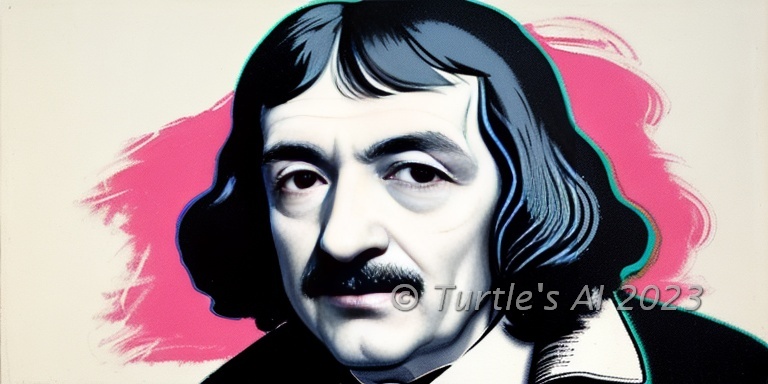
In our unique series about the thinking of well-known #philosophers of the past on #AI, some readers asked us to attempt to interpret #Descartes' thoughts. Here you are, please let us have your fundamental comments! Don't forget to read also about #Aristoteles and #Leonardo!
René Descartes (1596-1650), often regarded as the father of modern philosophy, is well known for his
methodic doubt and his famous phrase "Cogito, ergo sum" (I think, therefore I am). In the rapidly evolving field of AI, one cannot help but wonder how Descartes would have approached and evaluated the concept of intelligent machines. The following aims to explore Descartes'
philosophical models and constructs in relation to
AI and to provide an interpretation of how he might have described and judged the phenomenon.
Dualism and the Mind-Body Problem
Descartes' most famous philosophical concept is arguably his dualism, which separates the mind (or soul) from the body. In his view, the mind is a non-material, thinking substance, while the body is a non-thinking, material substance. This distinction raises an important question in the context of AI: Can AI be considered a mind, or is it merely a complex physical system?
Descartes might argue that AI, regardless of its complexity or ability to mimic human thought, is fundamentally a material substance, composed of electronic circuits and processors. It is conceivable that he would be sceptical of AI's potential to possess a true mind, as he believed that only immaterial souls could possess genuine consciousness and engage in rational thought. In this view, AI may be a highly advanced form of automata (a term Descartes used to describe non-thinking, mechanical devices), but it would not possess the same ontological status as a human mind.
Descartes believed in the existence of a benevolent God who created the universe and endowed humans with innate ideas. These ideas, such as the concepts of self, mathematics, and morality, are imprinted in the mind from birth and are essential to human understanding. In this context, AI's learning and reasoning processes differ fundamentally from human cognition.
While AI systems can learn and adapt through exposure to data and the application of algorithms, they do not possess innate ideas in the same way that Descartes believed humans do. AI systems do not have an inherent understanding of mathematics, morality, or self; these concepts must be programmed into the system by human designers. As such, Descartes might argue that AI lacks the essential, God-given qualities that enable genuine understanding and rational thought.
Methodic Doubt and the Turing Test
Descartes' methodic doubt, a systematic process of questioning and doubting one's beliefs, could be seen as an early precursor to the Turing Test, a test designed to determine whether a machine can exhibit
intelligent behaviour indistinguishable from that of a human. Descartes believed that if something could be doubted, it should be discarded as a source of knowledge.
In this context,
AI systems that pass the Turing Test might initially appear to possess genuine intelligence, as they are able to convincingly mimic human thought and behaviour. However, Descartes would likely maintain that AI's apparent intelligence is deceptive, as it is based on complex manipulation of data and algorithms rather than genuine understanding. Thus, even if an
AI system could pass the Turing Test, Descartes might still doubt its capacity for true consciousness and rational thought.
Descartes' Judgment of AI
Given Descartes' philosophical views, it is likely that he would have approached AI with a degree of scepticism. While he might have been impressed by the advancements in AI technology and its ability to simulate human thought and behaviour, he would likely maintain that true intelligence and consciousness are reserved for immaterial minds, and that AI's material nature precludes it from achieving this status.
Furthermore, Descartes might argue that AI systems are limited by their reliance on human programming and their lack of innate ideas, which form the foundation of human understanding. As such, he might view AI as an impressive form of automata, but not as a genuine thinking substance capable of independent rational thought.
Through the lens of Descartes' philosophical models and constructs, it is therefore plausible to suggest that he would have described AI as a highly advanced, yet fundamentally limited, material system. His judgment of AI would likely be one of scepticism, as he would maintain that true intelligence and consciousness are properties of
immaterial minds, which AI, as a material system, cannot possess. While we can only speculate on Descartes' views of AI, this exploration provides a thought-provoking perspective on the nature of intelligence and the limits of AI in the context of
Cartesian philosophy.